Flower Show Grump…

Last Friday, Julie and I went to the RHS flower show at Tatton Park. Sadly, it wasn’t the best day out we’ve ever had.

I needed that coffee!

The weather didn’t help; it was a very wet day. I think it’s the crowds I find most difficult. When it rains, everyone piles into the floral marquee, and the crush is intolerable. I had a plan to beat the crowds – do the outside bits when it was raining, and save the stands under canvas for when it was drier, and most people had ventured out. But that corresponded with a heavy and prolonged shower – we lasted for about ten minutes before the rain began to soak through our (supposedly) waterproofs, and we gave up and joined the melee inside.

I was able to chat with some of the suppliers, and pick up some brochures for garden structures, furniture, etc. – vital resources for my garden design work.

One of the biggest disappointments was the plant sales. ‘The place to buy plants’, the publicity material said. But something very strange happened on Saturday – something pretty much unprecedented. I came away without having bought a single plant. Not one! Why? Well, there were a number of factors. With the exception of a few stands selling unusual, lesser-known plants, most had the same, very limited range. For instance, I was looking for Achilleas, but there were mostly just two named varieties on show, both of which were unfamiliar (presumably new) varieties with daft names. I was after known, tried and tested varieties, with predictable growth habits.

Lysimachia ‘Beaujolais’ used in one of the show gardens

Lysimachia ‘Beaujolais’ has been on my wish list for sometime, so I was happy to see it used in a show garden. But could I find any for sale on any of the stalls? No I couldn’t.

This garden was designed to celebrate an anniversary – I can’t remember what for, but it wasn’t what you’re thinking!

There were at least three stalls selling an admittedly good range of allium bulbs. But why the repetition? And do you really want to plant allium bulbs this early? I don’t.

Most of the plants for sale (such as the Achilleas) were in full bloom, which isn’t the best way to buy plants (because the only way from there is downwards). I did see some that will flower later, such as Actaea (which weren’t on my list because, ironically, I stocked up on those earlier in the season). Asters would have been the perfect plants to sell – ready to put in the ground now, to flower around a month from now. But no. I guess they want to put on a display of plants that are looking good now, to encourage the customers to buy those.

And finally, plant prices were high (though not nearly as high as the price of a coffee!) I don’t know, am I expecting too much? You pay thirty quid entrance fee to a flower show advertised as ‘the place to buy plants’, only to find those plants are more expensive than at a nursery. Add in the rain and the crowds of people, very few of whom seemed to have any awareness of anyone other than themselves (although, perhaps they were thinking the same of me!) and, all in all, it would be much more pleasant to browse on-line for plants that are cheaper (and probably in better condition) from a nursery, such as:

Other nurseries are, as they say, available.

You can’t blame the organisers for the weather. The show began in that hot spell, which will have made things difficult for everyone involved, as well as for the plants. Thirty-odd degrees centigrade is difficult to work in anywhere, but in the UK it seemed eery, cataclysmic; plain wrong.

The show is big – so big that we missed some of the show gardens (should have paid more attention to the maps on the notice boards). I would have bought a show guide, but at £7 for what (I’m guessing) is probably mostly advertising, we gave that a miss. Maybe the RHS aren’t aware there’s a cost of living crisis?

The show gardens we did see, which were mostly the young designer gardens, were very good. Although why no-one thought to dissuade the designer of the paradise garden to put a shiny, lipstick-pink fountain at its centre, beats me. Apparently some features are banned at these shows. A tasteful gnome or two would have been entirely innocuous beside that pink aberration (the rest of that garden was very nice).

I’d show you more photos of the show gardens, but what with the rain and all the people in the way, I didn’t take many.

The stands in the floral marquee were very impressive too, with wonderful displays of cacti, gladioli, streptocarpus, and more. But getting into position to actually see them was stressful. Like many gardeners, I suffer back problems, and I find shuffling my way through crowds does my back no favours. So, after nearly four hours, we gave in to the cold, the wet, the crowds, and to ‘show fatigue’, and went away in search of somewhere to sit down in the warm with a coffee and cake (with the ever-so-slightly troubling feeling we hadn’t seen everything we could have, hanging in the back of our minds).

Yesterday, we watched the highlights from the show (recorded on one of the hot, sunny days) on Gardeners’ World, from the comfort of our living room. Which was, I have to say, much more comfortable…

text & images © graham wright 2022

The Curious Incident of the Earwig in the night time…

When your plants come under attack, it isn’t always easy to identify the culprits.

Our runner bean wigwam, under-planted with courgettes

We’ve had a lot of damage to plants this year, including the runner beans. They flowered, but no beans were forming. At first, I blamed the sparrows, with which we’re inundated, and which I know were destroying our spinach and chard (until we covered them with mesh). The sparrows were all over the beans too. But then I remembered when, a few years back, I’d grown the most glorious wigwam of sweet peas; as full, healthy and lush as anyone could wish for. But without a single flower. It wasn’t until I went out at night with a torch that I realised why: they were crawling with earwigs.

Flowers but no beans!

Another night-time foray showed it’s the same case with the runner beans. Flowers come out, the earwigs eat them, and no beans form. How do you deal with these tricky little varmints? Well, you can go out at night and pick them off, but they tend to scarper as soon as you start, and you’ve only got one hand to try and catch them with while you’re holding the torch.

Earwig nesting box!

An easier way is to put a plant pot stuffed with straw on top of the canes. The earwigs crawl up into the pot at the end of the night, thinking it’s a nice cosy, safe place to hide out during the day. Oh the naivety! Come daylight we tip out the pot and… well, you can guess the rest. Nightly hauls have varied between one and eleven. Hopefully we can get the numbers down sufficiently to give the beans a chance to do their thing, and provide us with a harvest.

The residents evicted into a plant tray

Many garden pundits will try to tell you earwigs are good to have in the garden, because they predate pests like greenfly. The reality is that not even the heaviest infestation of green or blackfly will leave you with no crop at all. A moderate infestation will do little damage, and provide food for other, less destructive predators, like birds, hoverflies and ladybirds. Earwigs may control aphids, but if they deprive you of a crop – either edible or ornamental – how are they helping? Aphids will at least share the spoils!

In my experience earwigs, like that other favourite of the so-called experts, the wasp, do far more harm than good.

text & images © graham wright 2022

Roses in June

June is perhaps the peak time for roses, and the roses in my own garden are all in full flower now.

This unknown climber pre-dates my arrival. It has a light scent, and deep, velvety red blooms

Roses can provoke a mixed response. On the one hand, they’re the icon of the English garden, and the nation’s favourite flower. On the other, they can seen as somewhat old-fashioned. I think this is unfair.

Roses have suffered from being badly used in the past. Mid-century rose gardens tended to be sterile and twee, with paths lined with lollipop standards, and hybrid tea rose bushes set out in isolation, often in a desert of bare soil, with heaps of farmyard manure around them.

Rosa ‘Lady of the Lake’ – a repeat-flowering climber with open blooms, allowing pollinators access to their nectar.

Nowadays, the trend is for roses to be more of an integral part of the garden. Modern shrub roses, climbers and ramblers mix well with other garden plants, and can work with most garden styles, from the formal to the traditional cottage garden, and even the currently popular ‘prairie planting’ (sometimes referred to as the ‘naturalistic’ or ‘new perennial’ style). There are roses to suit every style, and in most colours (except blue and black).

When designing my own garden I chose roses from David Austin.[1.] His roses emulate the old, romantic roses, but like all growers, he bred for vigour, attractive foliage, disease resistance, and a long flowering period. Particularly important, he didn’t neglect scent, and most of his cultivars have good fragrance. When designing a garden, this is an important consideration, because scent adds another, very delightful element to a design.

Climbing Rosa ‘Constance Spry’ grown on a metal pergola – this was the first rose David Austin bred. It has good fragrance, but sadly only flowers once.

Apart from the climbers, I’ve used shrub roses to add colour and scent to the borders. They benefit from dead-heading (a job I rather enjoy), but while correct pruning helps the overall shape, they’re not too fussy. They hold their own in a shrub and perennial border, as seen here…

This is Rosa ‘Dame Judi Dench, in amongst the perennials. The garden is in its infancy – both rose and perennials will expand to fill the gaps.
Judi in close-up!
Rosa ‘Gertrude Jekyll’ – similar to Constance Spry, but repeat-flowering, and with an even stronger scent.
Gertrude Jekyll in the border, with claret Rosa ‘Tuscany Superb’ further along.
Rosa ‘Tuscany Superb’

Roses are so familiar to us, we can easily take them for granted. But we shouldn’t overlook just how beautiful and useful they are in the garden, providing colour and scent, as well as lush foliage. There are roses for most situations, including shade, and many will flower from early June, right through the growing season. Climbers and ramblers will cover walls, fences, pergolas and arbours; or grow up into a tree. And shrub roses are perfect for the borders; used like any other small to medium sized shrub.

Rosa ‘Munstead Wood’

text & photos © graham wright 2022

[1.] There are many other rose breeders around, producing some superb cultivars. I have to say, prices for David Austin roses are higher than most other breeders. I’m not sure if that’s always been the case, and whether the company are playing on his fame (David himself sadly passed away a few years ago).

Bluebells at Hodnet

Just over a week ago, I visited Hodnet Hall Gardens near Market Drayton in Shropshire. It was a bright (if cool) day, and everything in the garden was coming into life. Hodnet has a series of lakes, with woodland walks around them. In places, the trees were under-planted with bluebells, and I was lucky to be there just as they were at their best…

The light was bright and clear, visibility was good, and there were some lovely reflections on the lakes. The swans were at their most serene…

Hodnet is one of two very impressive gardens close to where I live (the other being Wollerton Old Hall). Both are very special places, so if you’re ever in the area, do try to fit in a visit.

The circular garden – in a few weeks the peonies and roses will add a blast of colour

text & photos © graham wright 2022

The Dingle, Shrewsbury

I’ve lived in North Shropshire for over two years, and Shrewsbury is my nearest large town, but despite having sampled many of its delights on a number of visits, it wasn’t until about a month ago that I discovered the park known as ‘The Dingle’. And what a find! Set in a depression at the centre of an area of parkland known as The Quarry, The Dingle is what might traditionally be referred to as a municipal park. The wider area of parkland – grass and trees – is wrapped around by a bend of the river Severn, and the whole is overlooked by the pretty St Chad’s church (an attractive round building that from above looks curiously like the Starship Enterprise).

Contrary to so many municipal parks that are unloved (particularly in these hard times) The Dingle is very well cared for, with an attractive small lake surrounded by shrubs and perennial beds. There’s also an area of formal bedding – not exactly ‘on-trend’ but probably historically correct (I’m guessing it was set up in Victorian times).

I visited at the beginning of April, on a bright, if cool, day. The early season bedding of daffodils and tulips, wallflowers, primulas and forget-me-nots were looking bright and cheerful. There was blossom on trees, and the fresh, red shoots of the pieris were apparently undamaged by frost (it may be The Dingle’s sunken aspect lends it some protection). Quite a few of the rhododendrons were already flowering.

There are a number of interesting architectural features. The shoemakers’ arbour is a stone arch decorated with ancient statues of the two patron saints of shoe making, and bearing the initials of the wardens of the shoemakers’ guild (sounds like a lot of cobblers to me!) There’s a bust of Percy Thrower, who was apparently Shrewsbury parks superintendent.
And this is a statue of a nymph, Sabrina, associated with the river Severn…

They may have had a reputation for prudishness, but those Victorians did like their saucy statues…

text & photos © graham wright

Update on the Garden…

Work on the garden is, as they say, on-going. It’s mostly the patios and paths that are yet to be done. Strictly speaking, these form the main structure of the garden, and should be put in first. But as I’m doing these myself, in my spare time, and I’m no builder, they’re going to take some time. So my strategy has been to put in the living structure of the garden first, so that it can be growing, and enjoyed, while I gradually work on the hard landscaping. This, for instance, is Viburnum plicatum f. tomentosum ‘Mariesii’, a very pretty shrub with a layered structure and masses of white flowers in early summer, as well as good autumn colour. It’s one of the earliest of the shrubs in our garden to come into leaf…

You can see the flower buds that are forming, among the fresh green new leaves. This specimen is spreading well, and will hopefully put on some height this year.

There are still some beds unmade too. This one, close to the house, needs the edges to be built up and concreted in before it can be fully planted up. But I have managed to get enough of it done to plant the shrubs against the fence between the garden and the driveway…

In the foreground is a Viburnum x. Burkwoodii; the large flower clusters are sweetly, and strongly scented, so it’s a good plant to have by a path. Here, it’s close to the house too. Beyond that are two Pyracanthas (firethorns); good shrubs to train against a wall or a fence in shade. Last in line, and smallest, is a Chimonanthus (Winter Sweet). Once it’s grown up a bit it should have scented yellow flowers on bare branches in the winter. This bed will incorporate a semi-raised pond, with a fountain to distract from the neighbours who annoyingly make all their phone calls outside their side door (the popular expression ‘get a room’ comes to mind here). Hopefully the foliage will muffle the sound somewhat too, once these shrubs have grown up.

Elsewhere, the broom (Cytisus) by the pergola under the birch tree is in full bloom now. Broom seems to like our soil; there were several here when we arrived, and it self-seeds freely. You can’t see them, but there are pigeons nesting in this one. I’m not sure it’s a great location. The tree above them is frequented by crows and ravens, who are already giving the pigeons some harassment. I just hope they don’t take their young.

The small tree in front, yet to come out, is a Clerodendron trichotomum, bought from the lovely Burrows Gardens in Ashbourne, Derbyshire.

We planted some tulips in the beds, but also, we tend to plant the new bulbs in pots for a good show in their first year, and then move them into the beds when they’ve finished flowering. We’ve done this with tulipa ‘Balerina’ (orange), ‘Purissima’ (white), and ‘Konigen der nacht’ (purple), and Narcissi including ‘Thalia’, and most seem to be naturalising well (it helps that the soil is light and sandy)…

Spring annuals and biennials include Myosotis (forget-me nots – self-seeded, but positioned) and Lunaria (honesty) from seeds sowed by us…

I finally built a second compost bin, from re-claimed pallets, so I’ve closed off the existing one. The plan is to transfer the top layer from the old to the new bin so I can use the composted material at the bottom as a mulch. It’s on my list of jobs to do…

You can see I’ve put in a support structure for the raspberries, and tied them in. These are actually an autumn-fruiting variety, which should be cut to the ground in spring. But the summer-fruiting raspberries we put in didn’t grow. As the autumn-fruiting ones are reproducing like rabbits, I thought I’d stick with them, but try an experiment. Half have been cut to ground level, as normal, and the new shoots that should produce fruit in autumn are already coming through. The other half, I haven’t cut back, but have instead tied in. They already have flowers forming, and should fruit early. If this works, it will show that a raspberry is a raspberry, and whether it fruits early or late, depends upon the pruning regime.

The re-built raised bed at the end is looking quite good at the moment. Most of these plants were there when we arrived, though they have been moved around. I’ve added a Callistemon (bottlebrush) which is one of a few cuttings brought with us from our last place. There’s a rather nice alpine phlox in this bed…

At the weekend, I cut the grass for the second time this year, but this time I cut paths through the main area, and will let the rest grow longer for wildlife, and wildflowers, such as this speedwell…

…to which this photo doesn’t do justice. The flowers are closed, because it was raining. They’re small, but very pretty, in a striking mid-blue. The leaves are small, and a rich, mid-green, so a very good addition to a lawn – much better than grass, in fact.

The hedgerows around the garden are just coming into leaf now; mostly hawthorn, but with some holly, crab apple and wild cherry too. And at last the weather is warming up a little. So things should really get going in the next few weeks…

text & images © graham wright 2022

Evergreen or Deciduous?

It seems to me there’s always been a tension between the use of deciduous and evergreen trees and shrubs in gardening and garden design. I have to say, I’ve tended to favour the former. Maybe it’s because I grew up in a time when gardens were often filled with boring, uniform conifers; from large, quick-growing hedging plants like the dreaded Leylandii, to a proliferation of ‘dwarf’ conifers (many of which turned out to be rather bigger than expected).

Of course, some plants are more exciting than others, and that goes for both evergreens and deciduous.

Defending the deciduous…
People who favour evergreen plants point out that they give form, presence and greenery throughout the winter, whereas deciduous plants do their thing in the growing season, then shrink back to virtually nothing in winter, leaving then garden all but empty but for a few dead-looking sticks.
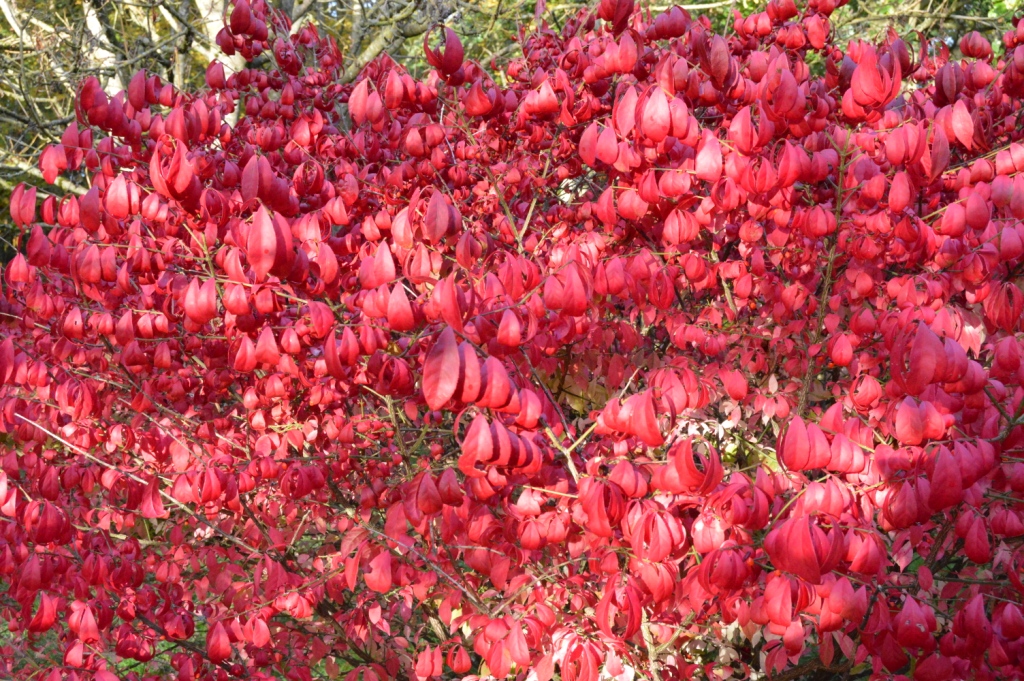
It’s true that deciduous plants are much reduced. But bear in mind many of them do something like this before they drop their leaves…

Euonymus alatus

Add in beautiful flowers during the growing season, and perhaps we can forgive them for being somewhat sparse in their dormant period. But actually, those dead-looking sticks are not as uninteresting as you might at first think. Denuded of leaves, woody plants display a form and structure that is architectural; sculptural, and very beautiful…

A mature beech tree at Hodnet Hall & Gardens, Shropshire

Their branches make interesting shapes. They change with the changing light. When it’s sunny, they cast bold shadows on the ground. They accumulate lichen and moss, which adds shading and texture. And in fact the idea all deciduous plants are dormant in winter isn’t correct either. Some of them flower on bare branches…

Hamamelis x. intermedia ‘Jelena’ – Witch Hazel

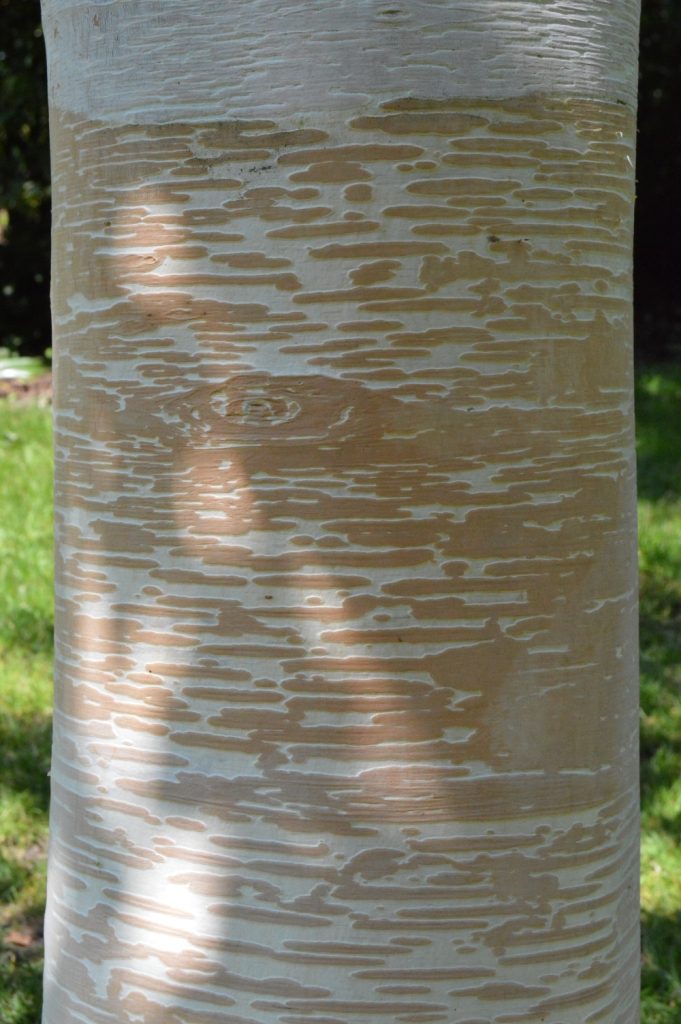
Others, particularly willow and hazel, produce attractive catkins. And once the leaves have fallen, we discover that many plants have beautiful stems and trunks…

The bark of an unlabelled tree (a birch?) in Dorothy Clive gardens , Shropshire
Cornus sanguinea ‘Midwinter Fire’ (Dogwood)

There’s something both very spiritual, and also rather scary about plants that are dormant during the winter. They speak to us of the transient nature of life. But they also highlight the great joy of renewal in spring; something you might miss if you only have evergreens.

Evergreens – not so boring after all…
While evergreen aficionados point to a lack of winter interest in deciduous plants, those in the opposing camp tend to think of evergreens as being boring. They may have presence all year round, but it never changes…

A rhododendron in full bloom in April at Bodnant gardens, North Wales

Start to think about it, and you realise that evergreens produce some of the most impressive and prolific blooms of all plants, from rhododendrons and camelias, to Olearia (daisy bush), magnolias, and ceanothus (California lilac). And far from being a uniform, dull green, they come in many shades, from dark to light, and leaves with attractive markings and patterns.

Euonymus fortunei

And many evergreens have something else to offer too. For as long as there have been gardens, people have indulged their creative tendencies by trimming plants into interesting shapes.

RHS Garden Bridgewater

The most useful plants for topiary are evergreens such as box and yew. There is, I suppose, a contradiction here, because how often do you see box, or yew for that matter, allowed to grow naturally, without being shaped? We value these plants so highly, but also see their natural growth habits as uninteresting.

Time to put aside favouritism…
The reality of course is that to maximise the impact and benefits of our gardens, we should make use of the features and advantages of both deciduous and evergreen plants.

Bodnant Gardens in April

In most circumstances the best solution will be a mix of evergreen and deciduous plants, chosen to suit the conditions and to compliment each other as part of a balanced design.

text & images © graham wright 2022

I’m a Garden Designer!

The more observant among you will have noticed I’ve been dropping references to my sister site into the last few posts. This year I finished my post graduate diploma in garden design (with distinction, no less!) I’m now a fully qualified garden designer, and I’ve set myself up in business under the name Strelitzia Garden Design (from Strelitzia reginae, or the bird of paradise flower). Here’s my logo…

What do you think?

I have a new website dedicated to the business (www.strelitziadesign.uk) with a blog attached. For now, I’m running the two blogs in parallel, but I’m thinking of pulling the plug on ‘Pulling Weeds’, and merging all of my content on Strelitzia. I’ll keep you posted on that.

My design portfolio consists of the projects I did for the course, but I intend to gradually replace them with live projects. I’m also working up the design for my own garden as the main portfolio project, the advantage being that I will be able to illustrate it with photos from the garden (once I’ve finished building it) and also show how it develops over the years. Obviously I’ll have full access to my own garden – something I would be unlikely to enjoy with commercial projects. This is my colour visualisation of the concept plan…

As you can see, it’s a very full design, with a mini orchard, ornamental trees, shrubs, herbaceous borders, a veg plot (with compost bins), herb beds, a pergola for climbers, a greenhouse, and a wildlife pond. Just as well it’s a large plot! The beds are deep – up to three metres in places – to allow for plenty of plants. This is definitely a design for plant lovers! it’s a mix of the formal and informal. The main area of grass, under the fruit trees (apple, pear, plum and damson) will be a wildflower meadow. A formal grass path edged with low box hedging will lead up from the house, with straight lines and angular offsets to keep the destination (a patio, and an arbour under the large birch tree at the end) from sight until you turn into the final straight. You could say it defines a journey through the garden, adding an air of mystery (if you wanted to squeeze two design cliches into one sentence). This effect will become evident as the garden matures, and the plants become fuller.

This is the front garden…

The hedging, tree and shrubs on the south side were there already. The rest was gravel. Working around the existing driveway, the design re-instates the lawn that was there a few years ago, but this time as a wildflower meadow (with added cultivated bulbs such as tulips and alliums). A new beech hedge around the boundary will take away the harshness of the bare wall and fence, muffle noise, and help to filter the wind that blows in across the fields. Two new trees in the meadow – a rowan (Sorbus aucuparia ‘Eastern Promise’) and a field maple (Acer campestre) will provide more cover and interest at a higher level.

As you’ll know if you’re not new to this blog, I’m quite a long way through implementing the design, although there’s plenty left to do. The planting areas have been my priority; to get the plants settled in to their new home so they can get growing. The front garden is done now. In the back, I’ve just got two more beds that I’m working on at the moment. The hard landscaping of the paths and patios will have to be done as and when.

It’s becoming more difficult to get work done outside now that there’s so little daylight, and the weather is either too wet, or too frosty to work. Progress has slowed down somewhat. But if I can get all of the beds made and planted before spring, I’ll be satisfied with my progress.

text & images ©Graham Wright

New Neighbours…

When designing a garden, it’s important to consider the wider landscape beyond your boundaries. Our garden is surrounded on three sides by fields. In the two years we’ve lived here the fields have ben used to grow maize, and then grass, which is cut regularly for hay. Just recently, the farmers have decided to cut out the middle man, which means we have some new neighbours – the field across the road at the front is being grazed by cows…

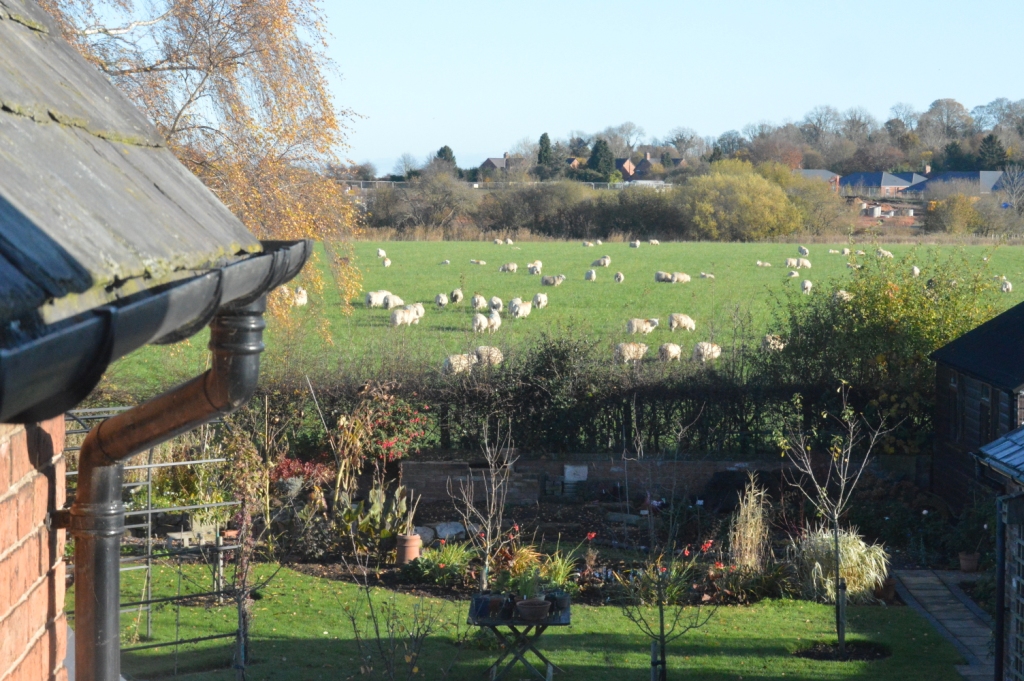
I know such intensive agriculture is harming the immediate environment and contributing to climate change, but I love to see animals in the fields. At least the poor things are getting some freedom. The field that wraps around the side and rear is now full of sheep…

These woolly fellas look like young males, which makes me think their eventual fate will involve mint sauce, which is rather sad, but I suppose that’s the way it works. I’m not going judge others for their choice of diet – we all have to eat – but personally, I wouldn’t (unless I was starving and had no choice). I’m tempted to open a gap in the hedge and usher some of them in to safety, but I know they would make a mess of the garden (and with no leaves on the hedge, I wouldn’t get away with it anyway).

Until a few days ago there was some good autumn colour in the garden, and the mature silver birch looked spectacular lit up by the late afternoon sun…

Of course, storm Arwen put paid to that; ripping off all the remaining leaves from this tree, along with most of the others. Overnight the wisteria went from looking as though it hardly knew autumn had arrived, to being leafless. The cannas were shredded, and lots of the plants in pots were blown about – one was even blown out of its pot (which is nowhere to be seen). We can probably consider ourselves fortunate that we only lost one tile off the roof. Oh well! Here’s looking forward to spring!

Sheep may safely graze… for now.

text & images © graham wright 2021

Last call for Spring Bulbs…

October and November are when most spring flowering bulbs become available at garden centres and nurseries. The priority for most people tend to be Daffodils (Narcissi) and Tulips (Tulipa species). The time at which they actually flower varies from one variety to another – by choosing varieties carefully you can have daffs and tulips in flower over a longer period. Daffodils will flower from Feb to April, Tulips in April and May.

Narcissus ‘Thalia’

Daffodils can be planted in the ground in October, but for tulips, it’s best to leave it until some time in November, particularly if your soil is heavy, as the bulbs can rot in damp soil (putting a little grit at the base of the planting hole can help to give more drainage to avoid this).

It’s not too late to plant daffodil bulbs now, or indeed many other, earlier bulbs such as snowdrops, though they may not flower quite as early as if you’d got them in the ground in October. The bad news is that retailers tend to get all their bulbs in at one time, and by now they’re running out. The good news is that they’re now heavily discounting whatever they have left. So while you may not get the full choice now, you can still create a stunning display, and at a much lower cost than if you’d been more organised and got your bulbs earlier.

Tulipa ‘Couleur Cardinal’ & ‘Spring Green’ naturalised in the garden

Many people use bulbs to create displays in pots. When it comes to tulips, growers supply bulbs that have been grown under ideal conditions, so that they will produce a large flower. The following year, the flowers are never as big, so won’t provide such a good display. But so long as you’ve chosen varieties that will naturalise, you can plant them in the garden when they’ve finished flowering, and they’ll come back year after year.

Here are the pots that I’ve planted this year, tucked away in a sheltered position by the house over the winter, and the remaining packets of bulbs that will be planted in the garden:

I’ve put the pots on blocks to keep them off the ground (pot feet are a better option, but expensive!) and covered them with netting to stop squirrels, voles, mice etc digging them up, as they sometimes do. I’ve planted daffodils ‘Hawera’, ‘Ice Follies’, and my favourite ‘Thalia’; and tulips ‘Spring Green, Queen of Night, and ‘Ballerina’.

Tulipa ‘Konigen der Nacht’ (Queen of Night)
Tulipa ‘Ballerina’

For a fuller display, you can mix different types of bulbs in the same pot, with tulips and daffs planted deeper, and smaller flowers such as chionodoxa, snowdrops, scilla, etc. set higher in the pot. I’ve been a bit lax on that front this year – I did throw in some chionodoxa and snowdrop bulbs I had from last year, but it’s mainly daffs and tulips.

The bulbs for the garden are fritillaria meleagris (snake’s head fritillary) and Camassia quamash for around the pond, and snowdrops and anemones for the shaded area under the lilac tree and rhododendrons.

Snowdrops (Galanthus)

Garden centres and nurseries are also selling summer flowering bulbs, such as lilies, which don’t need to be planted until next spring, and alliums, which should ideally be planted now (though like tulips, they prefer good drainage).

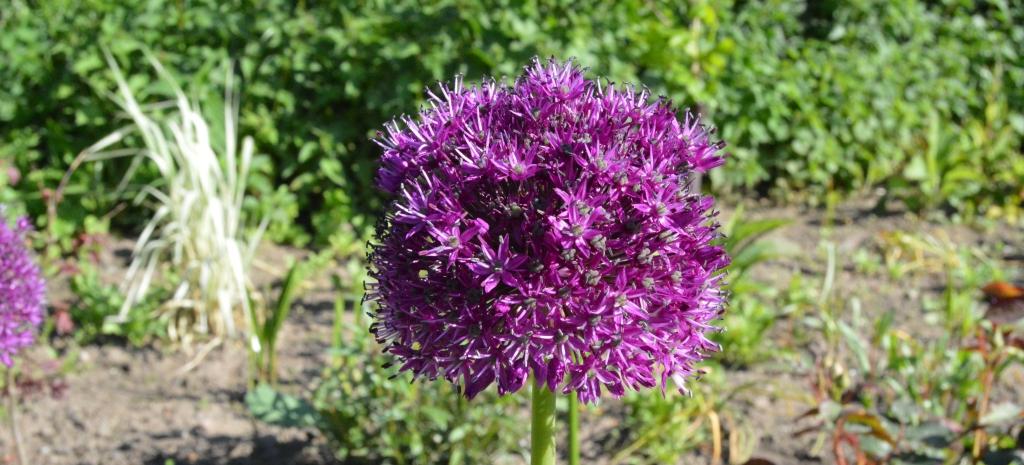
Allium hollandicum

Whichever bulbs you choose to plant, from the diminutive earliest flowering snowdrops, through daffodils and tulips, to the largest, most flamboyant lilies and gladioli; bulbs will give you welcome bursts of flower to look forward to next year.

text & images ©strelitzia garden design 2021