
Eager to get the main structural plants for the garden in the ground and growing, we decided not to wait until the ground was prepared, but to order the plants straight away. Impetuous? Certainly. Foolhardy? Perhaps. We hope to be living in this house for the foreseeable future, so what’s the rush? We’ve already bought and planted the bare-rooted specimens – beech hedging, and six fruit trees for our mini orchard. A few days ago we received a delivery from Burncoose nursery…

Actually, looking at the picture, it doesn’t look like that much! In fact, there’s the potential for a lot of plant material there. The plants were well packaged, arrived intact, and look like good, strong, healthy specimens. Two fastigiate (tall and thin!) beech trees (Fagus sylvatica ‘Dawyck’, and ‘Dawyck Purple’) will be tall focal points, giving the garden height, lush foliage, and great autumn colour. Two purple-leaved hazels (Corylus maxima ‘Purpurea’) will have large, dark leaves and can be coppiced every few years to provide hazel sticks for supporting beans, etc., or for fire wood. And, if we’re lucky, we might get some hazel nuts from them too.

A viburnum (Viburnum plicatum f. tomentosum ‘Mariesii’) will become a large shrub with fresh green foliage, horizontally tiered branches (a bit like a wedding cake tree) and will be smothered in masses of white flowers each spring.

Cornus kousa var. chinensis will grow into a small, spreading tree, covered in large white flowers (in fact, they’re bracts – the flowers are tiny and at the centre of the circle of bracts). It also has good autumn colour, and will make a great focal point, viewed through the metal pergola we’ve just finished putting up…

Of course the pergola will need plants to climb over it. So we got ourselves started with a chocolate vine (Akebia quinata) which has dark flowers that smell of chocolate (hence the name).

Clearing spaces in the borders where these plants will go is going to keep us busy for a while. Here’s a large patch we did earlier. There’s plenty more to do.

And to end on a prettier note; the Viburnum x burkwoodii we brought with us in a pot is full of flower at the moment. The fragrance is delicious…

text & photos (except akebia) © Graham Wright 2020
 Strelitzia reginae in Brisbane Botanical Gardens
 Snow in South Wales this morning
 Unidentified eucalypt in the incomparable King’s Park, Perth
 Olive and Agave plants basking in the Mediterranean sunshine on our balcony!
 Orchids in the ‘Cloud Forest’ glasshouse in Singapore’s ‘Gardens by the Bay’
 I know: I should probably get out more (by which I mean, beyond my back garden)!
 I’ve read that we shouldn’t be too quick to rid ourselves of all of the slugs in our gardens, because certain species predate other slugs. I’ve never really been convinced of this. Anyone who regularly goes out into their garden at night to search for (and eradicate) these slimy creatures will know that slugs will eat pretty much anything, from carrion to cat faeces. Kill a slug one night and you can almost guarantee to find three more feasting on it’s carcass the next. So while I have often seen slugs eating other slugs, I didn’t consider that to be proof of predation.
 Anyone who’s interested in gardening will have heard of Great Dixter. But despite having seen the gardens on various television shows, and read about them in magazines, I’d never taken notice of where they are. And so, when I picked up a leaflet earlier this week, while having a few days away in East Sussex, it came as a complete surprise to find that I was only twenty minutes away from Great Dixter. Obviously, I had to go, even though it had to be a shorter visit than I would have liked. Sadly there wasn’t time to look around the house, but the garden was the main priority.


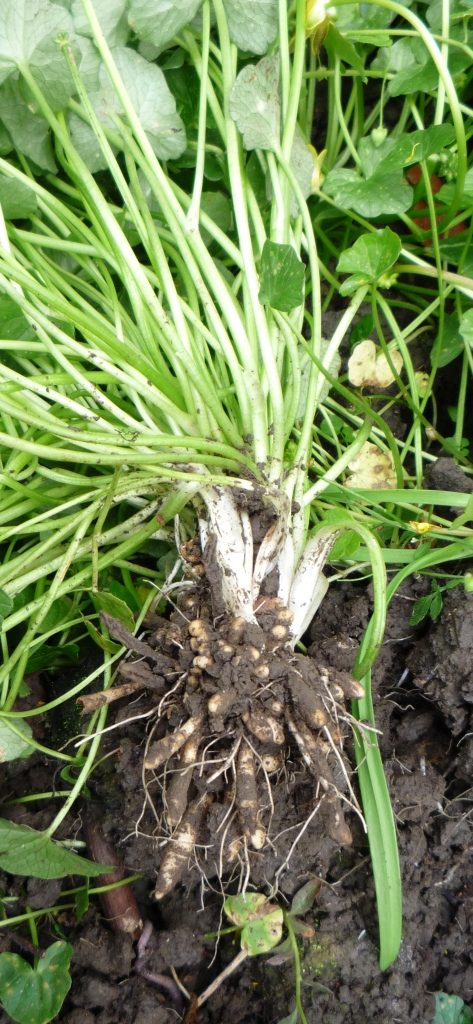 You can see these in the picture to the right. The RHS refers to these tubers as ‘tubercles’, which sounds a bit like a disease. And I can tell you that, faced with a patch of ground that’s covered in Celandine, it feels a bit like a disease too! You can never dig all of them out without leaving some of the tubercles behind, and if you’re not careful, by digging, you can turn a small colony into an infestation.


