10 Plants that struggled in the drought

After a string of dry years, this spring and summer were the driest yet. And although we didn’t have the record high temperatures seen a few years ago, it was still hot, with more sunshine than we’re used to, and drying winds that stressed plants further still.

As if that wasn’t bad enough, I’m gardening on thin, free-draining, sandy soil, which loses its moisture very quickly. So which plants failed to cope with these exceptional (or perhaps, no longer exceptional) conditions?

  1. Viburnum (Viburnum plicatum f. tomentosum ‘Mariesii)
    This is a glorious shrub, with fresh green leaves, a tiered branching habit, and branches smothered in clusters of bright, white flowers in late spring. Under normal conditions it’s dense and bushy, filling a large space. This year, by early August it had shrunk back, lost quite a few of its leaves, and those that remained hung down limply.

2. Phlox
This is Phlox ‘Peacock White’. Phlox prefer moist soil, so it’s no surprise this struggled, as it has done most years. You can see it’s trying to flower, but the flowers didn’t come to much.

3. Clerodendron trichotomum
A slightly rare shrub with white flowers and very striking berries, this too should have been full and lush. Shortly after I took this photo it went into early dormancy – we’ll have to see whether it comes back to life next spring.

4. Corylus maxima ‘purpurea’
A vigorous (normally!) large shrub with large, dark leaves. By early summer it was obviously suffering. This year it hardly put on any growth, and looked sick from early summer onwards.

5. Ligularia
Ligularia dentata ‘Midnight Lady’. This too is a moisture loving perennial. I planted it by the pond, in a bed with a pond liner beneath, to create a bog garden. Unfortunately the pond all but dried up, and the pierced liner beneath these plants couldn’t hold onto the moisture. The ligularias did eventually produce some flowers, but they didn’t hold up. The leaves would be expected to be large and lush.

This is what it should look like (as you can see, slugs and snails love the big leaves)…

6. Hydrangea (H. paniculata ‘Limelight’)
I have one large plant, and a few smaller ones, struck as cuttings. Hydrangeas are not known for their drought tolerance either, so perhaps not such a good choice. Having said that, planted in shade, it has been reasonably resilient. Until this year, at least. This photo too was taken in August.

7. Cornus kousa
A large shrub/small tree, grown largely for its showy white flowers (which are actually bracts – the flowers are tiny) followed by strawberry-like berries. Last year it only produced a handful of flowers. This year there were none, and the plant sulked from shortly after the buds broke. I’m wondering if there’s more to this than a lack of water. We do have honey fungus in the garden, so it could be this cornus is under attack.

8. Persicaria ‘Purple Fantasy’
Oh Dear! No amount of watering was going to save this rather vulnerable perennial. It puts up shoots early, which tend to need protection from the frost (unfortunately I didn’t get around to fleecing it). It’s first shoots were hit by frost. It sent out new shoots, but they too were killed off, by a late frost. It recovered again, but by August, despite attempts to keep them watered, all of the plants had shrivelled and died.
On the plus side, I split up some of the clumps and replanted them in shade, and with the wet autumn they put out some new growth, so there’s hope for next year. Here is one I moved (taken yesterday).

9. Aconitum
The flowers were poor, and the foliage withered before the flowers had finished. The late flowering ‘Carmichaelii’ varieties weren’t much better either.

10. Roses.
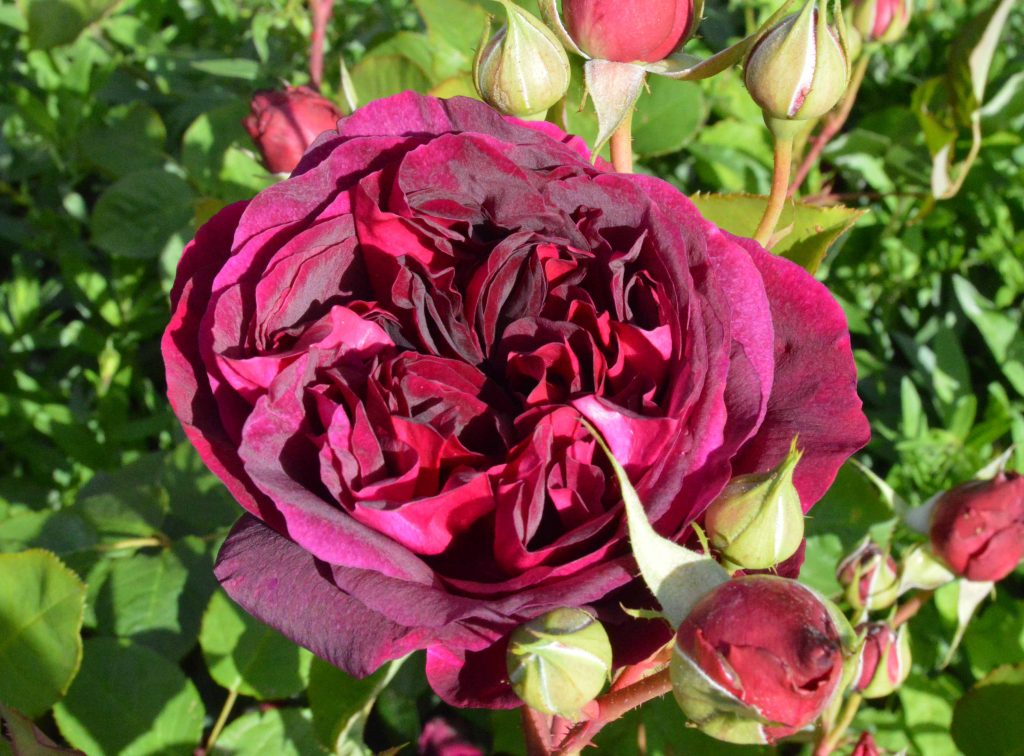
I’m beginning to wonder if it’s worth continuing to grow the traditional bush varieties in an open border. Rosa ‘Wollerton Old Hall’, a climber planted against a north-facing wall, did okay, as did Rosa ‘Clare Austen’ (planted against a shed, again facing north). ‘Dame Judi Dench’ (pictured), ‘Munstead Wood’, ‘Tuscany Superb’, and even ‘Gertrude Jekyll’ were sick specimens this year. On a pergola, ‘Constance Spry’ and ‘Lady of the Lake’ fared little better.

The flash of red behind gives a clue to the plants that coped well with the dry season.

In the summer, we did as much watering as we could. The four water butts ran out early on. I’ve been holding off, but I think it might be time to re-evaluate my planting plan. The problem is, of course, that if we switch to plants that like a Mediterranean climate, and then we get a few cooler, drier summers (because despite climate change, these things do go in cycles), we could find ourselves with the reverse of what we have now. I.e.; plants curling up and dying because it’s too wet and cloudy. Ideally we need plants that will cope with wet or dry, hot and cold – if such plants exist (actually, I think they do).

In my next post, I’ll highlight the plants that came through the drought unscathed…

Plants to survive a heatwave

For some years now, gardening pundits have been telling us we may need to move towards Mediterranean climate plants in our UK gardens. But this summer has imbued that idea with a powerful sense of urgency.

How many of us haven’t lost plants during this summer’s heatwaves? The true cost will only be known next year, when we will see what comes back, and what doesn’t. The heat wasn’t quite so intense up here in Shropshire. But even here, there were days when it seemed as if we were in Australia, or Arizona. The experts like to tell us what plants are most likely to survive those conditions. But you can’t beat first hand experience on the ground.

Plants in pots will always need to be watered regularly, along with those that haven’t been in long enough to have put down a good root system. But this year, I’ve also had to water some established perennials and shrubs, else they might not have made it through. There were some surprises.

Moisture-loving perennials such as Ligularia and Rodgersia were never going to like the heat. Mine are in a bog garden, but the water level of the pond that feeds it fell so low the boggy area dried out.

Border phlox, unsurprisingly, also suffered, but despite looking very sad, they made it through without being watered. I was surprised that Echinacea and Rudbeckia, which are prairie plants, needed regular watering. The RHS claim Rudbeckia came through well for them (apparently it has deep roots). They also said Eupatorium (which has, I believe, been re-classified as Eutrochium) did well, though it flowered earlier. My Eupatorium only reached 60cm, flowered late, and needed regular watering. Perhaps the difference is in the soil (mine is thin, sandy, dusty soil which drains quickly). The established Helenium got through (I may have watered it once).

Rudbeckia fulgida var. sullivantii ‘Goldsturm’ – flowering after the drought (and regular watering)

I may have despaired at the sad state of so many of the plants, but there were successes. Echinops, despite being big, leafy plants, were barely affected (and we had seedlings coming up all over the garden too). Verbascum and Achillea proved to be resilient, as did Verbena bonariensis. Gaura (which is now officially known as Oenothera), continued its campaign to take over the garden. Sedum (now Hylotelephium), being succulents, were able to store enough water in their leaves to get through.

Salvia ‘Royal Bumble’

Salvias, which are Mediterranean plants, were mixed. The perennial blue Salvia guaranitica ‘Blue Ensign’ would have died if I hadn’t watered it regularly, and failed to flower. But shrubby Salvia ‘Royal Bumble’ was undaunted, and has produced masses of flower from June onwards. It’s also self-seeded all around the plant (which is nice).

Iris sibirica, which is supposed to like damp soil, came through as if this year was no different to any other. It flowers early – before the heat struck – but afterwards, the leaves continued unabated. In fact, it clumped up so well I’ve recently had to divide the plants.

Iris sibirica

And last, but not least, Symphyotrichum reliably produced their tall mounds of foliage in the background, and have now erupted into bloom. They are one of my favourite perennials. Aster Munch came through too, but only just.

Symphyotrichums produce a fantastic show of bright daisies when all around them is decay and autumn colours

When it comes to shrubs, Viburnum plicatum ‘Mariesii’ flowered beautifully early on, but by mid-summer was all but dead. Cornus kousa, and the purple hazels (Corylus maxima ‘Purpurea’) were hardly any better. Deciduous Berberis hardly put up a fight before their leaves shrivelled and fell (the sawflies that regularly strip them must have been very disappointed).

Viburnum plicatum f. tomentosum ‘Mariesii’ – flowering before the heatwaves

This Cotinus has been in for a few years now, and hasn’t grown much (perhaps it doesn’t like the soil) but it wasn’t affected by the lack of moisture, or the heat…

Cotinus coggygria – taking on autumn colour

Hydrangeas are renowned for needing a lot of moisture, so it was surprising that Hydrangea ‘Limelight’ got through unscathed, and without additional water. Although it does have some shade – only getting the sun from mid-afternoon.

Hydrangea paniculata ‘Limelight’ The flowers change colour and then stay on the plant over winter. This one has produced a couple of fresh flowers in October.

Predictably, Ceanothus ‘Puget Blue’ was at home in the conditions, flowering and growing on well. Roses don’t generally like it hot and dry. Mine muddled through quite well, though they did have a long break in flowering (all except ‘Munstead Wood’, which kept on producing blooms, albeit rather slowly).

Rosa ‘Munstead Wood’

To mis-quote the late Jimmy Grieves; it’s been a funny old year Saint. Too cold for too long in spring and early summer. Then too hot during summer. And too dry throughout. The plants haven’t known whether they’ve been coming or going. Those whose gardens are predominantly Mediterranean gravel gardens will be feeling pretty smug right now. But for those of us who like a more lush look, it’s been rather stressful. Who knows what next year will bring…

text & images © graham wright 2022