Autumn fruits…

It hardly seems as though we’ve had summer yet, but looking at our apple trees, it suddenly struck me that the season is coming to a close. Perhaps their progress is ahead of schedule this year (although I don’t know why that would be with all the cool weather we’ve had, and the slow start to the growing season). These are apples on ‘James Grieve’, a lovely eating apple that can also be used in cooking. Sadly, it doesn’t store…

The tree is laden with fruit. I did some thinning earlier in the “summer”, but conservatively – I don’t like to take off too many because the trees will lose fruit in the ‘June drop’ and again in the ‘pre-harvest drop’, and if you’re not careful, you can end up with too little. Apples have been falling every day – exacerbated by the windy weather. All have been attacked by pests, and tend to have rotten patches and contain grubs (and sometimes an earwig will crawl out of a hole!) The grubs are, I think, larvae of the codling moth.

Looking at the apples that are still on the tree, most seem to have some sort of insect damage. I really must take more care to put grease bands on the trunks in good time next year (although the pests seem to find their way to the fruit anyway). The windfalls are fine, but we’ve had to cut them up, and use them quickly before the rot spreads, which is difficult because there are so many of them.

We have two apple trees. The other – ‘Worcester Pearmain’ has less fruit, but they’re a good size – last year it produced a crop of under-sized apples. This variety keeps much better – if we can find some that are undamaged.

The pears aren’t so good. ‘Packham’s Triumph’ isn’t living up to its name, having no fruit this year. ‘Concorde’ is better, but not exactly laden down. Although they are supposed to be in the same flowering group, there wasn’t much of an overlap, which could explain why fruit set was patchy. Touch wood, the pears don’t seem to suffer anything like as much damage from pests as apples; the one exception being wasps (of the social, yellow jacket kind) but so far, there have been very few of these this year.

Of the six trees in our mini orchard, it’s the damson that has grown the most, and this year it’s got quite a few damsons, which are ripening well. We’ve tried a few windfalls, and they were surprisingly sweet, but we’ll probably try our hands at making jam (a first!) with most of the crop.

The summer raspberries are in their first year (the first set of canes we planted didn’t take) but we’ve had some fruit from them.

The autumn raspberries have been a continuing trauma. Once again they put on impressive growth, but only one cane is producing fruit. The yellow berries are very tasty, but it’s a meagre crop for a whole, lush row of raspberry canes. At the end of the season I’ll thin the canes out a bit more, but leave some to see if they produce fruit early – alongside the summer ones. They should also produce new canes for autumn fruiting. This is known as double-cropping (thanks to Cathy at Rambling in the garden, who does this successfully and has been advising me). I wonder if my soil is short of potassium, which promotes flower growth? Wood ash is touted as a good source of potassium, so I may have to get the wood stove going this winter to provide a supply for next year.

The veg patch has given us a better crop of peas than in previous years, which we’ve tended to have raw in salads (there haven’t really been enough for main meals).

Broad beans have been similar. Both are coming to and end now.

The runner beans have been very slow again this year; it’s only now that they’re beginning to produce a regular crop from what is now a lush wigwam of plants.

While butterflies have been in short supply this year, there’s been no shortage of earwigs, which I suspect have been responsible for eating the flowers on the runner beans, and delaying the crop. I try to tolerate wildlife where I can, such as this caterpillar of a vapourer moth on the plum tree.

The fruit and veg may be telling us the season’s coming to a close, but the garden has more to give before autumn sets in. Asters grow well in our garden, and spread well too, so we have plenty of them. They’re close to flowering, and should put on a good show.

Hydrangea paniculata ‘Limelight’ has this year achieved something like its full size, with lots of large flower heads which will persist and look good (as they dry) well into winter. Hydrangeas are known to like plenty of moisture. The paniculata varieties are more drought tolerant, though as you can see from this photo, the leaves are somewhat droopy – we really do need some rain now.

Hesperantha (formerly Schyzostylis) is a tough plant that has spread freely around the pond. It’s a late flowerer, and is doing its thing now. In the background is a purple Lobelia x. speciosa ‘Tania’. Unlike the more popular Lobelia cardinalis ‘Queen Victoria’, which I’ve not managed to get through a winter, this one is in its third year.

And the Japanese anemones are in full bloom now. This is A. ‘Honorine Jobert’ against a dark backdrop of Actaea ‘Brunette’ (which is readying its fragrant white flower spikes as I write) in the white border…

Summer will soon be drawing to a close. It seems particularly unfair that while so far it’s been largely cool and cloudy, we’re in the middle of another drought. Maybe there’ll be some more warmth and sunshine (as well as rain!) to come before autumn. We live in hope. Actually we don’t – Hope is a small town in Derbyshire – but you know what I mean…

text & images © graham wright 2024

A senior moment…

Some of you may have noticed a little blunder on my latest post. Entitled ‘Hellebores and more…’ it was about day lilies, which are of course Hemerocallis, and not Hellebore. So many plant names, the Latin all seems to run into one after a while. Or maybe I’m getting old!

Hemerocallis and more…

It’s just over a week since we came home from twelve nights in Andalucia, to find the Hemerocallis (day lilies) were in full bloom.

I’d like to be able to tell you what varieties we have, but as they were all here in the garden when we arrived, and there were no labels, I don’t know. I’ve an idea the red one above (my favourite) might be ‘Stafford’. But I can’t be sure. I should do some more research. Some of the others we have come in unusual colours. This brown-maroon hellebore is quite impressive…

I’m not so sure about the next, which I would describe as flesh-coloured…

Before we went away, we prepared plants as much as possible, watering those in pots, and moving them into shade. The weather forecast showed mostly dull weather – not too much rain, but not hot. Never trust a weather forecast! We apparently missed the best of the summer, with 27 degrees centigrade one day, no rain (until the day before we got back) and quite a bit of sunshine. Consequentially, we lost some plants. Particularly upsetting is the Eucalyptus Moorei ‘Nana’ that I’d grown on from a tiny plant. Due to time constraints, and the weight of the pot it’s in, I didn’t move it into shade – a bad mistake. Oh course it might yet recover. But it looks dead to me (or as they say in Australia “It’s cactus, mate!) I guess that serves us right for going on holiday.

No-mow May, on the rear lawn, morphed into no-mow June, and now no-mow July…

At this point I would be inclined to cut the grass, but I’ve learnt from previous years that if you leave the grass long you get grasshoppers, and we have. So far, they’re only small. I love to have them hopping around – they really bring the garden to life. I don’t want to obliterate the habitat they need to complete their lifecycle. So we’ll just have to make the most of the meadow look for now.

Elsewhere in the garden, Helleniums are just coming into flower…

And this is Phygelius (again, it pre-dates our arrival, so I don’t know the variety). Not a plant I’ve had much time for until now. It often looks scrappy. And some varieties spread vigorously throughout borders and into the lawn. This one is a bit more shy, and I have to admit, it looks good at the moment…

We’ve planted quite a few Aconitums around the garden, and many are flowering now. I love their spikes of hooded flowers. Most are A. napellus varieties, but there are also some A. carmichaelii, which flower later. I’m still on the lookout for white-flowered varieties for our white bed by the house, after the supposedly white ones I ordered from a well-known nursery (who shall remain un-named) turned out to be blue!

I’m trying to introduce clematis into the garden because, as well as adding height, they look beautiful. But I’ve got my work cut out; probably because they don’t like our thin soil. The white Clematis alpina I put in was fine in it’s first year, but this year, it died. There are three type 3 clematis I’m trying. C. vitiwester, now in its third year, is feeble…

C. ‘Vanessa’ (pale blue) has put on more growth, and it will be interesting to see how the flowers turn out (it doesn’t flower until August).

We also have not one, but four C. perle d’Azur- all divisions from an unwanted plant I dug up from a customer’s garden. It’s early days, but so far they are doing alright…

The geraniums have been good so far. This is, I think, G. ‘Eureka’…

The maintenance has slipped a bit this year. Before we went away, we had our work cut out clearing the spent forget-me-nots we’d glibly allowed to set seed all around the garden (even in the white bed!) Since coming home, I’ve spent many hours pulling up the foxgloves before they spill millions of tiny seeds all over the beds. I’m leaving the white ones to seed, in the hope that we get more of those next year.

Another plant that seems to think it owns the garden is Verbascum chaixii ‘Album’. Unlike the foxgloves and forget-me-nots, this is a plant we bought. We started with two small perennials…

As you can see, it grows very easily from seed. And has huge tap roots. As I’m working my way through the large, main bed, I’m realising that many of the other perennials have been overwhelmed by a combination of foxgloves and verbascum. This bed was looking very overcrowded. It needs both more structure, and more diversity. I’m taking out all of the foxgloves (there are already more coming) and starting to judiciously edit the verbascums (with the intention of removing spent flower spikes from those that remain, before they set seed). It’s already looking better.

Lastly, an oddity. I believe we started out with three plants of Iris chrysographes; a black iris. There is only one left, but it flowered well earlier this year, and now has large seed pods forming. So perhaps I can grow some more on from seed.

text & photos © graham wright2024

Foxgloves

The foxgloves are in full swing now. These useful biennials seed themselves around all over the garden. Those that are where you don’t want them to be can be pulled out easily (and make a nice clump of greenery to feed to the compost). I probably don’t ‘edit’ them as much as I should.

Here and there a white one pops up. Last year I tried to dead head the purple ones and allow the white to seed, because I prefer the white ones (particularly in the beds where I’m aiming for a white theme). Clearly, I wasn’t very successful.

You can, supposedly, tell what colour flower the seedlings will produce by looking at the stem colour (the purple ones have darker stems and veins) but this hasn’t worked for me. Perhaps I didn’t study them hard enough. The purple forms are pretty too though.

Sweet rocket (Hesperis matronalis) can self seed too. The year we grew them from seed they filled the borders, but they’ve diminished in the following years (too much ‘editing’?)

These campanulas were here before we arrived, and also seed around freely. I’m not complaining – there’s nothing like having beautiful plants for free!) Like the foxgloves, some of the seedlings turn out white. Most are in shades of lilac.

Keeping on the theme of self-seeders, we planted Phacelia as a green manure one year, and loved the flowers so much we couldn’t bear to dig the plants into the ground. They too come up year after year. The flowers are pretty, long-lived – even in a vase – and have a sweet smell like honey. And the bees absolutely love them.

On a more cultivated note, we were disappointed last year with how quickly the Allium hollandicum ‘Purple Sensation’ flowers were over. Allium Christophii, on the other hand, lasted much longer. So we bought some bulbs of those last autumn, planted them into pots (thank you Monty Don and Gardeners’ World for that tip) and popped them into the garden in spring.

Here are some more of the highlights at the moment…

Baptisia australis (apparently native to America, not Australia!)
Rosa ‘Claire Austin’
Planting around the pond is filling out – Iris sibirica, hostas and Ligularia dentata ‘Midnight Lady’
Stipa gigantea (oat grass). Close up, you can see the pretty, tiny, yellow flowers
Rosa ‘Gertrude Jekyll’ – one of the best roses for fragrance
Salvia ‘Nachtvlinder’ – I’ve given up with ‘Amistad’, because I’ve been unable to over-winter it. ‘Nachtvlinder’ has smaller flowers, but is fully hardy

The garden moves on at pace, and I feel a weight of responsibility to try and fully enjoy each new highlight as it happens, and before it’s over without me having even noticed!

text & photos © graham wright 2024

Roses, At Last…

It’s been a long time coming, but finally we have roses blooming in the garden. I don’t know why it’s taken so long. We’re quite exposed – the wind blows in across the open fields of North Shropshire. But there’s a native hedge, with hawthorn, blackthorn, crab apple, and others, around the garden. Before we moved here it had been kept cut back to around a metre and a half high, but we’ve let it grow up and fill out, so it should be providing good shelter. This isn’t the warmest area in the country, but neither is it among the coldest. And other plants are no later than elsewhere (fruit trees, for instance). Maybe it’s the soil – dusty, sandy soil wouldn’t be the first choice for a discerning rose. Never mind, they’re here now. This is ‘Gertrude Jekyll’…

And below is ‘Munstead Wood’, another David Austin Rose, though for some reason the company have discontinued it. A shame, because, as you can see, it’s a lovely rose, with a rich burgundy that’s difficult to find elsewhere. I really must try taking some cuttings (don’t tell David Austin!) These pictures were taken during a period of prolonged, mostly heavy rain yesterday, hence the blooms are looking a little sad (wouldn’t you be too?)…

For the past two seasons we’ve had problems with the flowers on our roses. Something, I suspect, is attacking the buds, Sometimes the tops appear to have been nibbled away, so they don’t come out properly. With others, there’s a more fundamental level of damage which results in a completely distorted (often quite small) flower. The yellow rose in the front garden was particularly badly affected last year. Every flower it produced had ragged petals. I’ve yet to identify the culprits. It could be wasps – they’ve been known to munch on rosebuds or, more likely, earwigs – we get a lot of those. But I haven’t caught either of these red-handed. In fact, I’ve not seen any pests actively attacking buds, either during the day, or at night. I’ve not found anything in my mini horticultural library (i.e., my gardening books!) that helps. I may have to ask the RHS (members can contact them for help with specific problems). I pruned off most of the damaged buds and flowers without thinking to take photos, but I managed to find a few that don’t look right this morning. This is a red climbing rose that wasn’t affected last year…

This is a damaged bud doing its best to open on ‘Gertrude Jekyll’…

And this is on the yellow rose (it pre-dates my time in the garden, so I don’t know the variety)…

If any of you have ideas about what might be causing the damage, I’ve love to hear them. It’s always a shame when plants are attacked. But I guess that’s just the way nature works. We have to try and create a balance in the garden and then hope for the best.

Climbing rose ‘Lady of the Lake’

text & photos © graham wright 2024

Early May Highlights

The garden is growing rapidly now, with something new to see every day. Most of the trees and shrubs are well on the way to being in leaf, and the warmer temperatures of the last few days are really pushing things on. Around the pond, the camassias have put on a better show than I was expecting. They’re quite dainty looking plants – the ones I’ve grown before were more robust, with thick, strappy leaves. It could be that these are a different variety, or it may be because the soil we have here is thin and sandy…

These photos were taken around a week ago, and already the flower spikes are nearly finished – they don’t last for long! In just a few days they’ll have been replaced by the iris sibirica. There are a few out already, and the rest will follow soon.

These came with me from my last garden (or at least, a clump did). And those were a division from a lovely customer in Penarth. They are incredibly successful, bulking up quickly, and able to be divided within just one or two years. There are now numerous clumps around the pond, and some that have been planted elsewhere too. They don’t flower for ever so long, but the faded flower spikes continue to look good all year.

The tree peony had half a dozen blooms this year. A few years ago it nearly died, and I suspect what we have now has grown up from the rootstock to replace the grafted plant. But it’s still impressive…

After a slow start, the hostas are coming good. This is ‘Patriot’…

And this, ‘Halcyon’…

I split two of the large ferns that were here when we came and spread the offsets through the shadier spots in the garden, and they’re doing well so far…

The two Fagus sylvatic ‘Dawyck’ trees that I planted (one green, the other purple) are out, and beginning to gain some presence. This is the purple one, with the Viburnum plicatum Mariesii in full bloom behind and to the left, and a white rhododendron on the right…

We’ve got the first Allium hollandicum (‘Purple sensation) out (the rest are close behind)…

The chives are out too, and the first Eschscholzia flower…

This solitary kaffir lily (Used to be Schizostylis, now Hesperantha – thanks botanists!) seems to have got confused – it’s compatriots won’t be flowering until late summer…

And the first of the large butterflies has made an appearance. This, I believe, is a peacock…

There are other things happening, but I don’t want to overload you. Lets just say that the daily wander around the garden is a joy at this time of year (especially now the weather has warmed up).

text & images © graham wright 2024

Tulips

Like many people, we planted tulips in containers (last November) to make a show in spring. While ours survived the wet winter without any problems, the wind and the storms have been more of a challenge. Our pots have been in and out of the greenhouse to protect them from wind and rain damage (and then in and out of the garage, when we realised the warmth and light of the glasshouse was bringing them on too quickly!)

We limited ourselves to three varieties; fifteen of each – Queen of Night (Purple), Princes Irene (Orange) and Spring Green (cream/green).

There is a problem! As you can see in the next picture, only three of the Spring Green turned out to be Spring Green. The other twelve are a frilly yellow number – not really ‘us’!

We bought them mail order from a certain well known nursery with the initials S.R. (a little clue for you). This is not the first time we’ve bought tulips and been given the wrong cultivar (though that was from a different supplier). And then there were the white aconitums that turned out to be blue (a different supplier again). I think this must be a common problem, as on Gardeners’ World last week Monty Don was showing off a whole bed of vibrant magenta tulips that he had expected to be a much softer tone. So much for planning. To re-work an old joke;

‘How do you make a plant supplier laugh? Give them your garden plan.’

Despite the unexpected colour, the bulbs were good quality, and of a size to give a big flower in their first season. It’s generally recognised they will produce smaller flowers in subsequent years (some people – wasteful souls – throw their bulbs away and start afresh each year). Less extravagant folk (I’ve got that in common with Monty) will plant their tulips in the garden once the show is over, in the hope they may naturalise – the flowers may be smaller, but they still make a good show.

Tulips we put in the garden seem to have declined since last year – probably due to the wet winter. Ballerina seems to have held up well…

Others varieties, such as Prinses Irene, Queen of Night, and Negrita seem to have largely gone, but for a few isolated survivors…

The same is true for the white variety Purity. As for Pieter de Le Leur; last year it was fine, but this year the plants and flowers were so attacked by an unidentified critter, they were unrecognisable.

Daffodils too have suffered. Tete a Tete, and the regular tall, yellow trumpeted varieties were as good as ever. But there aren’t many Narcissus ‘Thalia’ left. These few are in the white (except for the invading myosotis, of course) bed by the house…

Talking of forget-me-nots, the garden is awash with them at the moment. If I’d had the time, I would have edited the self-sown seedlings out a little more. On the other hand, they do look good – very romantic…

Another self-seeder that has really taken off this year – a biennial – is honesty (Lunaria)…

Things in the garden are moving at pace now, with something new to see every day. The Chocolate vine (Akebia quinata) is flowering on the pergola. Unfortunately our resident wood pigeons have taken a fancy to the new leaves, shoots and flowers, so the plants hang down well, where they are out of reach, but are looking a bit bald on top (I know how they feel!)

And thanks to the (relatively) mild winter and lack of hard frosts, this year the three Pieris are showing undamaged (so far) bright red/pink new leaves.

It shouldn’t be long now before the first of the roses are flowering (if they survive the current strong winds ravaging the garden as I type). I can’t wait.

text and photos © Graham Wright

Late Winter Highlights…

The weather hasn’t been conducive to gardening, but there are plenty of signs of life in the garden now. While some narcissi don’t flower until much later, these early ones have been out for more than a week now…

There are crocuses (croci?) coming up all over the garden, including these yellow ones around one of the apples trees…

And these Crocus tommasinianus, which we planted in the lawn. I’m hoping they will eventually form large swathes, but so far, they’ve been sparse, and rather fragile…

There were hellebores in the garden when we arrived. I’ve moved them around as I implemented my design. As yet they aren’t exactly thriving (I need to bulk up the organic material in the thin, sandy soil) but they are providing some flowers…

Cherry Prunus x. subhirtella ‘Autumnalis rosea’ can produce flowers at any time through the autumn and winter, and it’s really full of blossom now. Not the most blousy of cherry’s, but worth it for the out-of-season blossom. The dark cloud behind shows it up well…

I planted a low hedge of the evergreen Sarcoccoca, another winter flowering shrub, close to the house for the rich, sweet fragrance that now greets us every time we venture outside the back door…

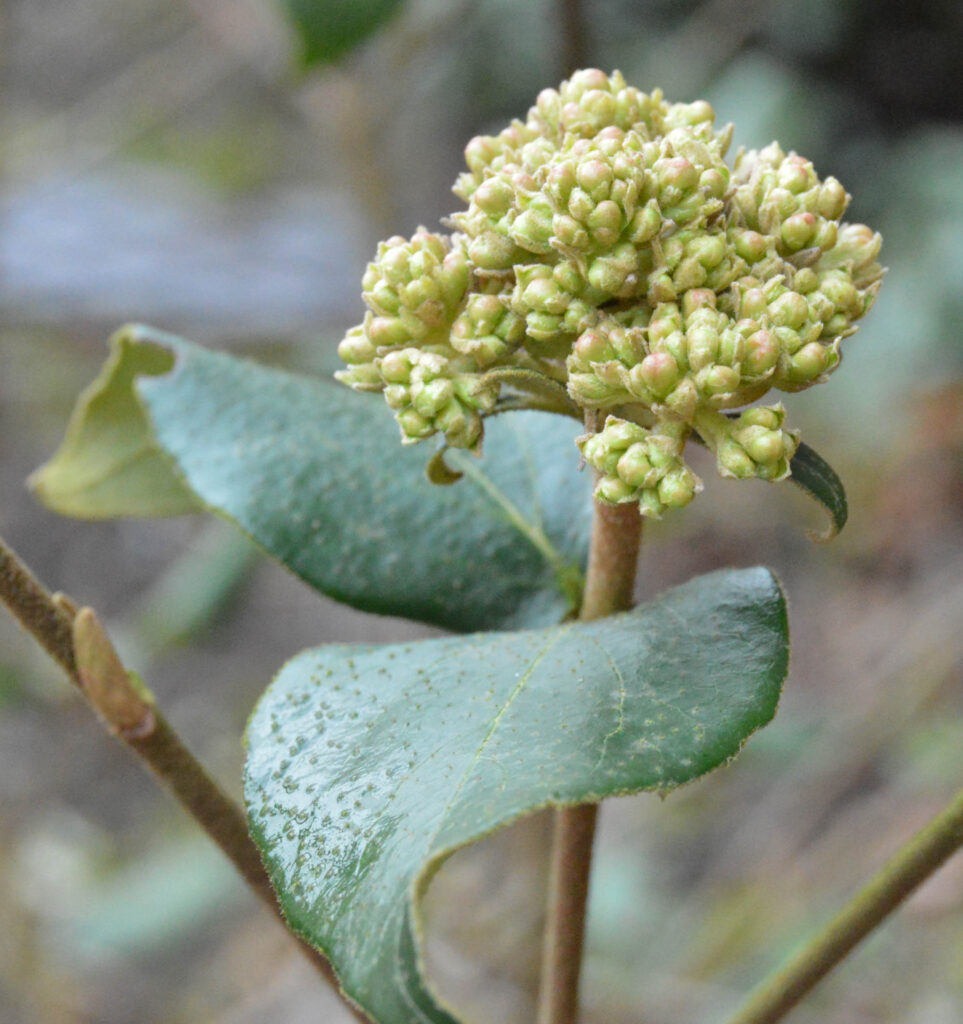
And close by a Viburnum x. Burkwoodii, which will in time make a large shrub, is preparing to open clusters of small white flowers. This too has a lovely, strong fragrance. It’s semi-evergreen, meaning it holds on to some of it’s dark green, glossy leaves – how many depends upon how harsh the winter is…

Snowdrops are all over the garden – they do seem to like the soil, and are bulking up well. Here, in a raised bed beneath a mature silver birch tree…

…and in our little ‘woodland garden’ outside the kitchen window, where rhododendron buds are swelling, and delicate Pieris flowers are almost out (the staked tree is a Liquidambar styraciflua ‘Slender silhouette’ which is now in it’s second year)…

Pundits will tell you snowdrops prefer shade, and soil that doesn’t dry out, but for us they are also flourishing in full sun, at the base of a fence, in a narrow bed of dry sandy soil. Never make assumptions about what will grow where!

Also in the woodland area there is a skimmia which, like the rhododendrons, I moved from elsewhere in the garden. The move doesn’t seem to have done it any harm…

Dried heads of Hydrangea paniculata ‘Limelight’, in another shady spot, are persisting well into winter, and looking good in the low light…

And a young Acer griseum (paperbark maple) is already displaying the peeling bark that the plant is known for. As yet, it’s only around a metre high, but it’s been in the ground for around three years, so I’m hopeful it will take off this year. As well as the attractive and unusual bark, Acer griseum is also one of the best trees for autumn colour…

Spring bulbs are pushing through the soil now. For the second year running we’ve bought more allium bulbs for the garden, and followed the advice of Monty Don, of Gardeners’ World fame. He suggested planting them in pots, to be put out in the garden once things have started to grow. The advantage is you avoid the danger (when planting bulbs into the ground during the dormant season) of digging up other bulbs. It’s also easier to ascertain the best positions to fit what’s there already. Here they are, in pots, ready to go into the beds soon (these are Allium Christophii)…

And last year we put new tulip bulbs into decorative pots. For now, they’re still in a sheltered position near the back door, but soon we will move them out into sunny positions on patios…

There was a cold snap towards the end of last year, but overall the winter has (so far) been rather mild; if wet and windy. There may be another burst of icy weather to come yet, but it feels as though the worst of the winter is over, and momentum is gathering for spring. We’ve even been feeding the goldfish!

Text & photos © graham wright 2024

Autumn Garden…

As we go into Autumn, flowers are in short supply, but some of the roses are still producing a few blooms, including this one, which is Rosa ‘Judi Dench’…

At the base of the fruit trees, nasturtiums are still going well, perhaps because they germinated late; the early seedlings having been nibbled off by hungry rabbits

Asters (Symphyotrichum) have seeded themselves all over the garden – I had no idea they would be so prolific! While the main plants have gone over now, some of the seedlings are in full bloom…

The quality of the new plants is variable. Some have flowers that are somewhat small; very similar to a very vigorous aster that was in the garden before we arrived (and which I subsequently split up and re-set). Others are closer to the bigger bloomed varieties we’ve added subsequently. One seedling has white, rather than lavender/blue flowers.

Another enthusiastic self-seeder is the ubiquitous Verbena bonariensis, and there are plenty still in flower…

Marigolds would be everywhere, but were also demolished by the rabbits. Some that made it through in the vegetable plot are still doing well…

In the first year we sowed some Phacelia as a green manure. The flowers were so pretty, and so loved by pollinators, that we decided not to hoe the young plants back into the soil. They too self-seed every year. They flower over a long period…

The flower spikes of Gaura (now Oenothera) lindheimeri ‘Whirling Butterflies’ keep going over a very long season, and float above everything else, creating quite a dreamy effect. It does need to be kept in hand, or else it will take over the garden…

‘Royal Bumble’, a woody salvia, surprisingly came through last year’s cruel winter, and has been amazing again this year, blooming from mid-summer into autumn. And it looks good with a backdrop of Cotinus coggygria (I think this one is ‘Royal Purple’)…

Geranium ‘Eureka’ has a few flowers left, alongside Achillea ptarmica ‘The Bride’, which we grew from seed in spring…

Anemone x hybrida ‘Honorine Jobert’ is another late flowerer. It’s just coming to an end now. It looks great in a shaded position, as here…

Colour, of course, doesn’t have to come from flowers. I put in an Artemisia ‘Powys Castle’ earlier this year, and its silvery foliage looks great against the dark leaves of the Cotinus

Fruits typically give us clusters of reds and oranges that intensify the orange glow of any low sunshine we’re lucky to get at this time of year. This summer I realised there was no need to dead-head the roses that flower only once (I can be a bit slow sometimes!) and consequentially, we’ve got rose hips. These are on the climber ‘Constance Spry’ (named for the famous flower arranger)…

And of course there’s the obvious colour from turning leaves; here in Rhus typhinus

This Euonymus alatus ‘Red Cascade’ is in its first year, so still quite small. The leaves turned a deep red, but I wasn’t quick enough with the camera – they’ve almost all fallen already…

The Cornus behind the pond (C. sibirica ‘Alba’ and C. sanguinea ‘Midwinter Fire’) are looking good as the leaves begin to change colour…

The falling leaves will reveal brightly coloured stems in red and orange, which will add interest throughout the winter.

Interesting how different trees and shrubs come into leaf, and shed their leaves, at different times. Last autumn I also put in a Liquidambar (L. styracyflua ‘Slender silhouette’), a columnar tree with great autumn colour. I was disappointed that it was one of the last trees to come into leaf in spring, but conversely, it’s leaves are yet to turn.

Elsewhere, the ferns are looking good now. This is Polystichum polyblepharum (Japanese Lace fern)…

Who would have thought it, but we’ve still got courgettes..!

In the greenhouse, the peppers and chillies were something of a disappointment, but there are some peppers still to be harvested…

Streptocarpus (or ‘Streps’ as they’re referred to) are generally used as houseplants, but I know from previous experience they like it outside over summer. This one was on its last legs, until we put it outside. I’ve moved it to the greenhouse now…

Things are changing fast in the garden now, as it turns darker, colder, and wetter, and one by one the deciduous plants start to shed their leaves. But don’t think it’s all over until the spring. Once the leaves are down, the garden will enter another phase; less flamboyant, but still with lots of interesting things happening.

Text & images © Graham Wright 2023

The Garden in September

It’s been another strange year, weather wise, as we begin to feel the effects of anthropomorphic climate change. After a hot and dry June, July and August were cold and damp, and many plants were slow to get going. I lost most of my dahlias in the cold winter (even those stored in the shed). The one survivor is this Dahlia ‘Bishop of Leicester’, which against all odds came through, despite being left to fend for itself in the border, with not so much as a thin mulch to keep it warm. It’s only now beginning to produce a good crop of flowers.

My ever-expanding collection of Cannas was also decimated by the cold winter (probably just as well – they were multiplying faster than the broomstick in The Sorcerer’s Apprentice!) Growth has been so slow in this (mostly) cool, damp summer, that none of the survivors have flowered yet. They’re running out of time.

The roses were late to flower this year too, and have only just started flowering again, after a lengthy break. These two are R. ‘Wollerton Old Hall’, a new addition thriving against a mostly shady garage wall, and R. ‘Munstead Wood’…

R. ‘Dame Judi Dench’ has proved to be the most consistent for flowers…

Looking at the successes, scabious sown from seed last year were slow to establish but are looking good now…

Geraniums are garden stalwarts, able to do well in most soils and conditions. This one is G. ‘Eureka’…

The single flowers are good for the bees too. As are Hylotelephiums (formerly Sedum) which are coming into their own now. This is Xenon…

Other plants that are having their moment in the limelight, at the end of the season, include Anemone (this is A. ‘Honorine Jobert’)…

And asters…

Which were actually renamed as Symphyotrichum (how those botanists love to make the lives of us horticulturalists difficult!) They seem to love our soil. Curiously Aster ‘Monch’ (which wasn’t renamed) has been sulking since I planted it three years ago.

Rudbeckia ‘Goldsturm’ has been good this year…

And the Hesperantha’s (which used to be called Schizostylus – best keep to the common name of Kaffir Lily!) are going from strength to strength around (and even in) the pond…

I know from past experience they can be invasive. The clumps quickly become congested and less floriferous. I’ve found an easy way to keep them under control is to just pull out the flowered stems (before the seed is ripe, else they’ll set seed everywhere). A section of plant will generally come out with the stem, but that leaves the newer offsets, which will provide next year’s blooms, with space around them.

Another plant which thrives in the thin, sandy soil, is Gaura (which, you guessed it, has been renamed -it’s now Oenothera lindheimeri ‘Whirling butterflies’)…

It self-seeds everywhere, and creates clouds of small, white flowers on long stems. Very pretty, although it does tends to sprawl all over its neighbours.

Yarrow (Achillea) is a wildflower (or weed, if you prefer) that we let grow here and there in the garden…

This is the wild form of a widely grown cultivated plant. The flowers are actually almost as good as the cultivated varieties, though without the range of colours, and look good and last well in a vase. The foliage is attractive too.

It’s been a dreadful year for apples, with almost all the fruit affected by moth larvae, and many of the fruits small and not properly formed. Keeping wasps from destroying what harvest there is, has been a challenge. Conversely, the pears are having their best year so far. This variety is ‘Concorde’…

It’s been another challenging year. Perhaps the most important lesson to be learned from the variable conditions, and weather extremes, is to observe which plants hold up well in your garden, whatever the weather throws at them, stick with those, and introduce others that are related, or like similar conditions. Having said that, I do like a challenge!

text & photos © graham wright 2023